Sometimes a poet effortlessly pens the perfect words to capture a moment, an image, or a feeling into a flawless poem. More often, if she’s like me, her first attempt is scrawled upon a page with imperfect rhythm, a clichéd phrase or two, clunky lines, and rhymes that feel a bit forced. Sometimes, if I’m lucky, there’s a glimmer of something worth holding on to. But it’s in the revision that the words become a poem.
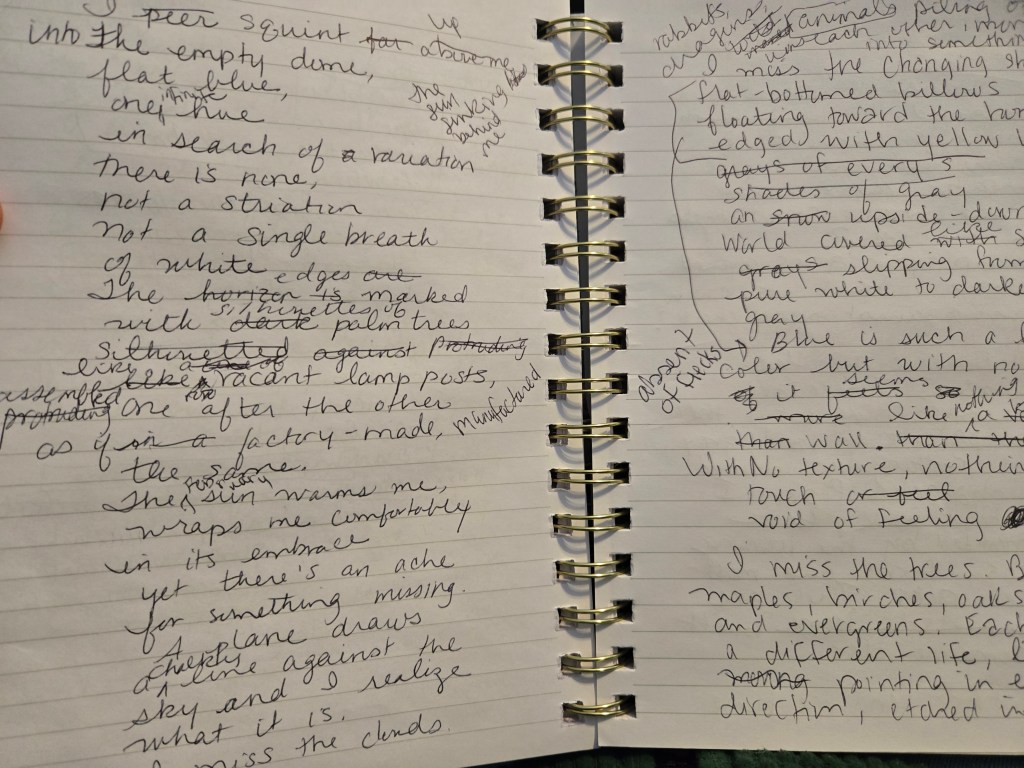
Composing comes easiest to me when I’m using a pen on paper. I think this is because it lacks a feeling of permanence and allows me to write ugly and messy without worrying about how presentable it is. When it’s on paper, it is for my eyes only, and it’s more about the process of feeling or creating; the lines flow more readily and I write them down as quickly as they come, the words slipping from my mind onto the page until the train of thought comes to a stop. Then, if I’m lucky, it forms some semblance of a poem.
In my initial drafts, my writing slants across the page, dips into the margins, flows in and out of cursive. Often, as soon as I write the words, I cross some out; I rewrite, draw arrows, rearrange phrases. And then I turn the page or close the book and let it sit for a while, knowing that thorough revising comes later, if at all.
Maybe I’ll think about it again as I lie in bed, or I’ll find myself rewriting lines in my head the moment I wake up in the morning (or sometimes in the middle of the night). Maybe I’ll write another version, or maybe I’ll forget about it altogether until I’m flipping through my writing some day in the future, hoping to find something of value. Not every poem will be worth a second look. Sometimes it was just a passing thought I needed to get out.
Every now and then, there’s a poem worth spending a little more time with. That’s when I type it up. And the work of revision begins. As the poem takes shape on my computer screen, I start to carve my words into something more tangible, more meaningful, consulting a thesaurus to find the precise word for the idea I wish to convey. I play with the lines, the way they break or flow from one to the next, trimming off excess or adding details to bring the image into full view. I say the words aloud, listening for the rhythm of my phrases, and I sharpen the sounds with devices that make the words zing.
Revision takes time, sometimes weeks or months. It takes time spent away from the poem and time to work and rework the words. It takes getting feedback from others and then more time making the words just so, with the reader in mind. (See also “The Art of Receiving Criticism.”) But the effort of revision is worth it. Seeing how the poem evolves into the best version of itself is the reward of time well spent.
Some poets, simply put, are literary prodigies, or sometimes a writer’s words just come together like a wondrous miracle. Sometimes, though, a great poem requires fastidious effort, and that grit and toil is in the drafting. For me, it comes after. It’s then that I revise, dig deeper, tend to the lines, and when the words truly bloom into a poem.
Thank you for taking the time to read this blog post. If you enjoyed my words, please let me know in the comments and consider subscribing to receive future posts directly in your inbox. Thank you!
Discover more from Denise T. Drapeau
Subscribe to get the latest posts sent to your email.
 Denise T. Drapeau