The Art of Receiving Criticism

Receiving criticism, no matter how constructive it’s meant to be, is difficult. Even when we know that something we wrote (or said or did) didn’t hit quite right, negative feedback can be tough to take, not necessarily because it hurts our egos or reminds us of our flaws, although that might be part of it, but because it means there’s more work to be done. And that can be overwhelming. 

You may begin to question everything. Where do I go from here? How can I fix the problem without undoing it all? How can I make changes without losing the essence of my work, without unraveling the entire piece? Or should I? Should I ignore the holes, patch things up, start over completely, or scrap it altogether? 

The answer comes in the pause. 

Sit with the criticism for a moment, an hour, a day or two. Wash the dishes, take a shower, go for a walk or a drive. Be where your hands are busy, where your phone, computer, or pen are inaccessible (or make them so), where you can think about your words, your storyline, your character–or not think about them–for a while.

Remind yourself that you wanted the truth. You wanted someone else’s eyes and ears. You asked for others’ opinions and expertise. You sought readers. You hired an editor. You wanted someone to give you honest feedback, or at least you thought you did. 

Sure, it’s nice to receive only kudos and glowing praise. But that doesn’t make your writing better. That doesn’t make your story work or your poem flow. That doesn’t make people see what you want them to see or feel what you feel when you put down your words. You want to make your writing mean something to your readers. So trust them to know how to help. Let others show you where you may have gone astray, and be open to their suggestions. 

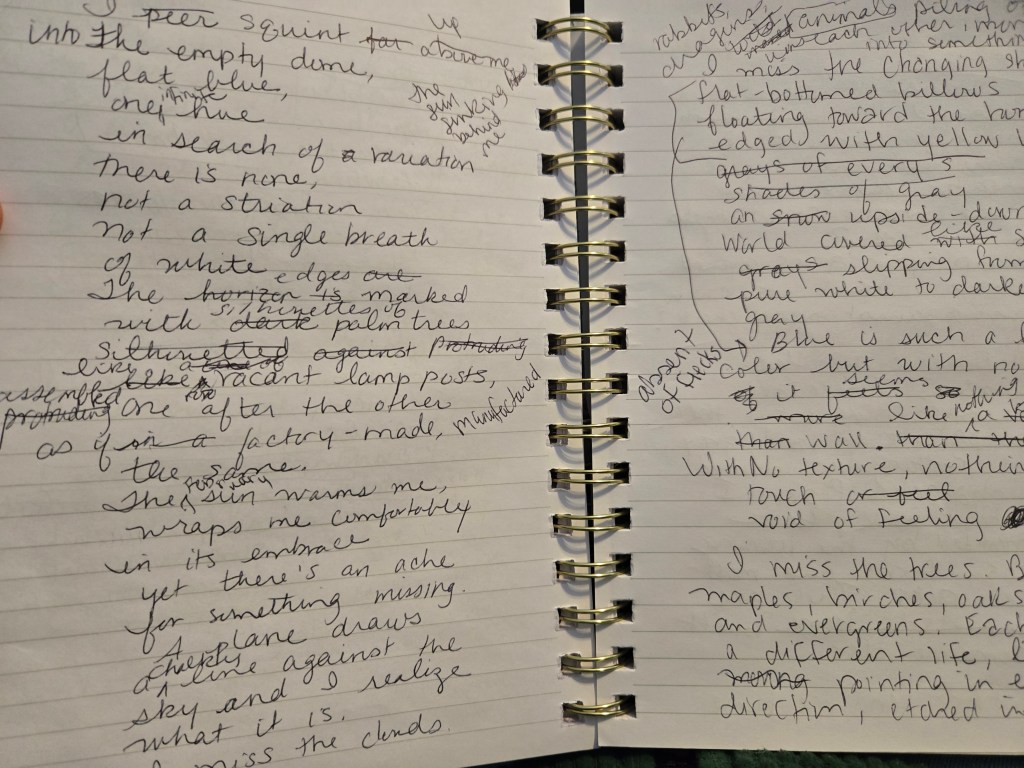
When you’re ready to make changes, start slowly, with the tiniest thread. Not the delicate, tricky spots, but the easy fixes. Start with an edit that, now that you’ve sat with it awhile, makes perfect sense and won’t take much time to smooth out. In a poem, it might be an “of” or a single comma or where you broke a line in two. It might be a word that doesn’t quite work the way you intended it to. Maybe, in truth, you can’t remember why you chose to use it in the first place. And you begin to realize how helpful the feedback was. You find yourself nodding along to the notes and comments as you read through them again, and you see how right they were. Soon, you’ll get into the rhythm of revising, much like the way the words unfolded onto the page in the first place, expertly stitched in a steady line.

You may come to a wrinkle, your words jamming as you try to correct them. These things happen. That’s when you need to back up, clear the tangle, and start again. Maybe there’s feedback that still doesn’t feel right; it’s okay to stand by your words. Trust yourself too. You know what you need to do. 

Remind yourself that you are a writer. You are a storyteller, a poet. And revision is part of the process. You must let others try things on for size so you can repair the tripping hazards that get in the way. But then, do what you do best. Trim off the excess, clean up the edges, rearrange the colorful pieces, and secure them in place with tight little stitches. Let the feedback you receive, along with your own inner voice, guide you until the fabric of your handiwork comes together seamlessly to create something beautiful, and better than it was before. 

Whose Woods These Are

A poem for Robert Frost

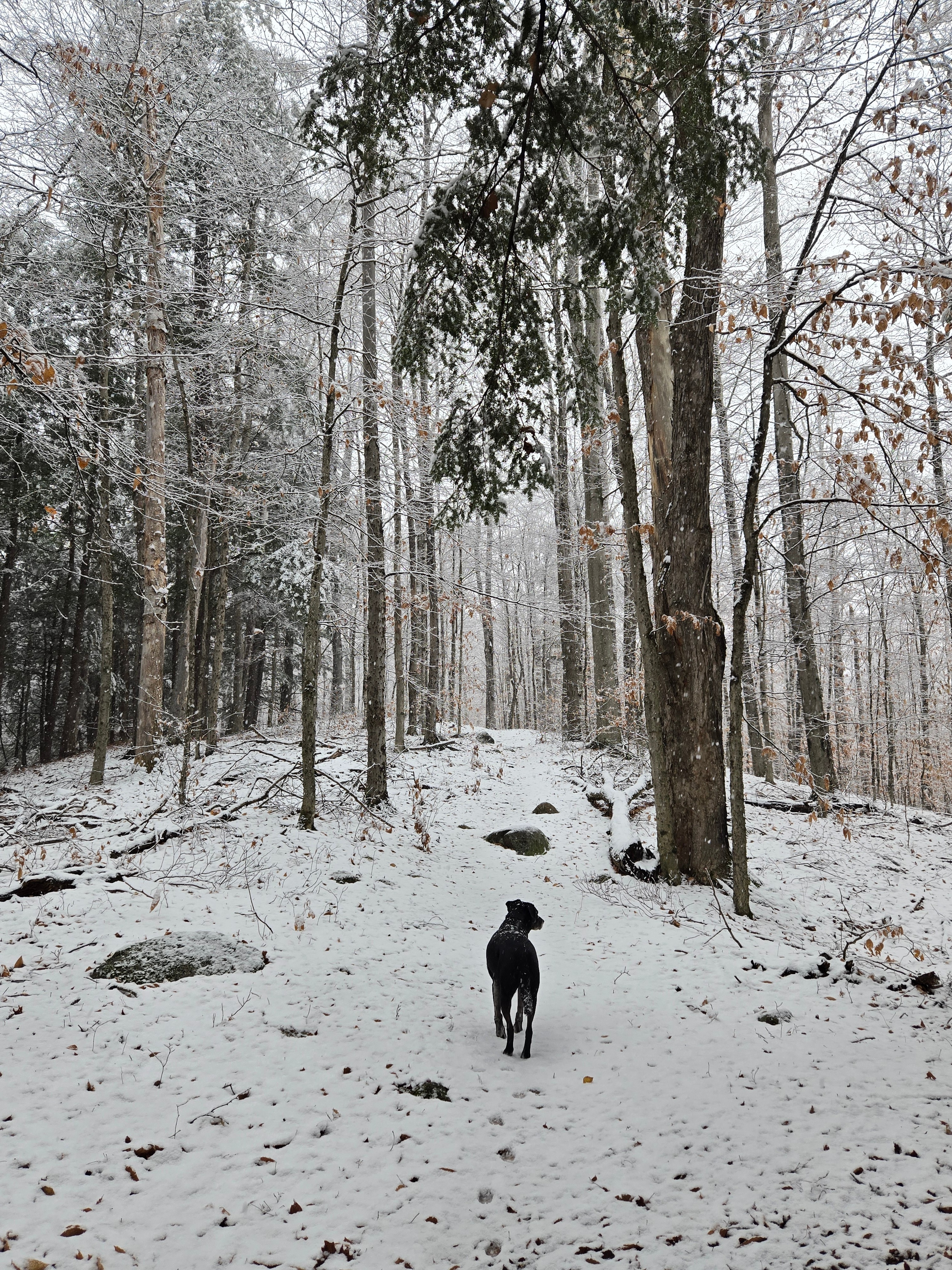
These woods are mine. I think I know

the path beneath the drifts of snow

because my cozy house sits near;

the land is someone else’s though.

They do not see me walking here

on every morning of the year.

My little dog, he doesn’t fail,

with snout to earth and listening ear,

to lead the way along the trail

between the hill and hidden vale.

We do not make a sound or peep

as I meander on his tail

and ponder, as I climb the steep,

the secrets of these woods so deep,

though they were never mine to keep,

though they were never mine to keep.

.

January

January

Look at you, all photogenic,

waltzing in with bells on,

draped in your fancy firs,

with your fancy words

and promises of something new,

throwing confetti around like resolutions

that get lost in the scuttle

as the dust settles on the items that need to be returned

cluttering up the kitchen.

You put up snowmen on doorsteps, standing by,

poised for insurrections.

And you shut us in,

locked in our homes,

afraid to venture out

for fear of infection,

for fear that ice is closing in.

You incite a biting wind

that rips through,

stirring up worries

instead of the hope

you were supposed to carry with you

when we turned the page.

Yet we’re still holding on,

still resolved that you’re not all just pomp and show,

that you’ll bring us what you promised.

But you’re running fashionably late

.

A Rock, Some Talk, and a Walk

I’m writing the second part to my story, a sequel, a story I never thought I’d write. My first was a standalone; it had been resolved, or so I thought. Sometimes things change. Sometimes new stories, stories inspired by life, beckon to be written, and sometimes stories come together in beautifully unexpected ways.

I was working on a scene for my new novel, feeling a bit stuck, when my dog needed to go out. I reluctantly closed my laptop, put on my shoes, and took him for a walk in the woods behind my house. Despite my slight annoyance at the interruption, I welcomed a reason to get outside, where I do my best thinking – and writing. On the quiet trail, where the only sounds were the cadence of my footsteps and my dog tromping through the leaves, I found the inspiration I needed. The pieces coalesced in my mind to form the perfect idea for my story.

Sometimes that’s how it works; sometimes it takes getting outside, changing up the scenery, gaining a new perspective to see the path the story should take. Sometimes even when you think you know exactly what is going to happen, exactly where you’re headed, an interruption, an obstacle, a twist will emerge out of nowhere. Sometimes that makes all the difference. 

I had a plan for my first novel, a fully-detailed outline of how things would go, but it took a very long time for that plan to come to fruition because, well, life. When I finally sat down to finish writing the story, the end result was much different than it would have been had I completed it all those years ago. Rather, it became an amalgam of all the years, all the experiences, all the people, all the images, all the stories that had been part of my life during that time. Although I sometimes wish I had stayed on course and finished what I started back then, I am cognizant of the fact that it would not be the iteration it is were it not for the time that passed, the events that transpired, the moments I lived, the person I became – and I am proud of the version it is as a result of, well, life.

I began writing my second novel without a plan. I had the time and a few scattered pieces – a rock, a girl, a boy, a walk in the park – parts of a whole, that didn’t yet connect, but I knew somehow I would eventually figure out a way to bring them together. So I just started writing, stumbling along, making it up as I went. 

Sometimes magic happens when you don’t know where you’re going. Sometimes you just need to seize the moment, push aside the doubts, stop waiting for the right time, and begin. Sometimes the answers are lingering beneath the surface, waiting to be found. 

I’d plucked a rock from the ocean a few summers ago. I was walking by myself along the shore when the smooth oblong stone caught my eye and I picked it up. As I strolled back toward my family on the beach, holding the rock, a story (a different one) came to mind about a boy and a girl and a rock. I sat by the water jotting my ideas for that story – to save for another day.

Last summer, I was prospecting for nuggets of inspiration when a friend suggested an exercise to generate ideas for my second novel: make a list of the items in my character’s backpack. As I began writing and piecing together fragments, I recalled this advice. So, naturally, when my character dug through her backpack on the first day of school, lo and behold, she pulled out a rock.

This rock appeared in chapter one, but as I was writing chapter six, I realized it hadn’t surfaced again, and I questioned whether the progression made sense, whether it fit in the story at all. So I asked my oldest daughter what she thought. I had been sharing my story with her; she’d been reading the chapters and giving me feedback. When I wasn’t sure where to go next, we chatted about the direction of my story. I told her my concerns about the rock, and I talked out the options, but I still wasn’t quite sure where it belonged – or whether I should throw it out altogether.

I was walking along the trail behind my dog, still pondering what to do with the rock when I recalled another recent conversation I’d had, this time with my middle daughter, who has an interest in psychology. I told her about the paper I wrote as an undergrad for my child psychology class about the teens at a Bat Mitzvah who took turns singing into a microphone, boys grabbing it from girls, girls grabbing it from boys, boys and girls holding onto it together, and how they seemed to use it as an excuse to be near each other, for their hands to touch. Reflecting on that observation, the pieces started falling into place, the fragments forming an image of a scene, the story becoming clear in my mind.

I hiked back up the hill toward my house, hurried inside, and wrote, in awe at the serendipity of it all. A walk in the woods, conversations with my daughters, a paper I wrote thirty years ago, advice from a friend, the rock I pulled from the ocean, and countless other random, scattered memories and moments came together like a jigsaw puzzle, like magic, and merged into one perfect, pivotal encounter without which the story would not be the best version of itself.

There are a million different directions one’s story might go. The writer chooses her own adventure, or sometimes the adventure chooses her. Sometimes the magic lies in collecting the pieces that had been strewn about, overlooked, long forgotten; sometimes it takes painstaking effort to sort through them, polish them up, give them meaning, and make something beautiful of them. Sometimes the beauty was there all along. Sometimes stories happen randomly, unfolding in unexpected ways. Sometimes they turn out better than we ever would have imagined. 
A New Page

If you subscribe to my blog, thank you. Thank you for reading my thoughts and following my writing journey.

I hadn’t posted anything in a while, until today. I was updating and tinkering with my website, and I inadvertently reposted an old blog entry that, if you read it for the first time, may have seemed out of place given its references to the last Presidential election. I caught the error, but I couldn’t undo it, so I just had to let it go.

That happens in life. We make mistakes, things we wish we could undo, things we wish we could unsay or unwrite. But we can’t. So we just have to roll with it. And try to move on, try to make things better. That’s all we can do. Because our mistakes are only part of a much longer story. They don’t define who we are — unless we let them.

I’m starting a new page, putting my passion and energy into something new. I don’t know how it will go, but I’m giving it a try. Because that’s all I can do. Sometimes we just have to take things as they come and do the best we can to be the best we can be. It’s a work in progress, like life. Bear with me as I reconstruct my website and turn the pages of the next chapter.

Thank you. Thank you for seeing beyond the stumbles and missteps. Thank you for believing in me.

There She Goes

Sometimes we call our manuscripts our babies. The works in progress we’ve been pecking away at for more than a decade. The novel we’ve spent years trying to perfect, preparing to send out into the world for others to see.

Recently, I finished the novel that began as a tiny infant, just a glimmer of hope with an infinitesimally small idea of what would come of her. I sent her off to publishers, not really sure what would happen next, with excitement and much anticipation for the future, a little bit of dread that I didn’t get it right, didn’t do enough to make sure it was ready, and sadness, that those chapters are done, never to be written or even rewritten again.

And yesterday, I sent my real baby off to college. My tiny infant has become a full-fledged adult being, though still awaiting some fine-tuning as the time marches on, but as prepared as she can be for the next step.

In a lot of ways these babies are similar. Sending our writing babies off into the next phase of their lives is a lot like sending our children off to college. I wake up in the middle of the early morning, before the sun comes up, and I start to worry. Did I do everything I could to prepare her? Should I move things around? Should I change things up? Should I revisit our conversation? I worried. I worried that things were going in the wrong direction, that I’d messed up, that I couldn’t fix her problems, no matter how hard I tried. Over the years, I woke up many times imagining dialogue and scenes in the darkness. It never went quite the same as I practiced in my head, but most of the time it turned out much better than I thought it would. 

In my heart, I know that I did everything I could to help make my baby become the best she can be. I read books. I took her outside to explore. I brought her on adventures. I nurtured her. I made mistakes and learned from them. I did better the next time. I added color and texture to her experiences. And even when I had my doubts, even when I worried that she might not turn out exactly the way I envisioned, I loved her the whole way and knew she was the best thing I’d ever created.

I’m sad that this book is closed, that I can’t go back and relive the pages of this story anymore. But as hard as it is, I know that it’s time to move on to something different, something new.

I’m excited for that. I’m looking forward to whatever comes next. And I really have no idea what will happen. Will there be rejection? Will there be heartache? Will the things I thought were done still need more work? Will she find where she belongs? Will she be accepted right away? Will she change for the better? I’m sure there will be many surprises along the way, both good and bad. That’s scary, but it’s thrilling, and I’m just happy to be along for the ride.

They’re very different too. Sending my baby off to college is not at all like sending my manuscript out for publishers to see. She’s a piece of my heart that is irreplaceable. I begin writing my next story, and my thoughts turn to this new character, with his own struggles and desires. I wake up thinking of ways to make his story better, and I’ve all but forgotten about the last story I wrote. It doesn’t work that way in real life. I have two other works in progress at home, with worries and desires of their own, but we don’t move on so easily to the next thing without still wishing she was part of it. She is, but her role is different now. It’s written in text messages and appears on phone screens. In some ways, we now get to see a part of her that we never knew before, the part with her own big stories to tell, with her own plot to create, with rises and falls and a happy ending – and many new beginnings – we couldn’t begin to predict. Now she’s a little more on her own, where she depends on new people to help her become the very best version of herself, but she’s still my baby. And I can’t wait to see what happens next.

Discovering My Style

I recently enrolled at Southern New Hampshire University (online) to pursue a Master’s in English and Creative Writing. In my first course, Studying the Craft, I’ve already learned so much, and for someone like me, it has been a lot of fun!

For a recent assignment, I was given the task of selecting any five words from a contemporary text, and then using them in a short work that showcases my style. Before now, I never knew I had a style! But when I sat down to write this piece, I realized that I do. Even though I borrowed individual words from another writer, these words are all me.

We ascend the trail in silence. I find comfort in the cadence of our footsteps. His jaunt a lilting quick-step, slightly ahead. And I struggle to keep pace.

I didn’t sleep well. Awoken with a sudden flash of all things unspoken, all tasks undone. My backwards count, cascading into a restful state only to be jolted alert again. 

It seems too early now to be outside. The sun still lingers behind gray and violet mountaintops. But we continue on, leaves crinkling beneath our feet. A crow recites soliloquies from its lookout above our heads. I fixate on the caw. A harsh but friendly greeting. 

He stops, turning back, asking if we should trek on. 

“Go,” I reply, like a crow.

He picks up the pace, and I lumber along, my thoughts returning to today’s to-dos. 

As we reach the pinnacle, the sun, ringed with wisps of yellow clouds, raises its crown above the majestic peaks. I am awakened, uplifted. I breathe in the morning.

He peers at me, watching as I take in the view, and I wonder what he’s thinking. But I begin our descent without a word. He follows after me, traipsing at my heels.

We step inside. His energy has drained into me. I am ready to work, charged, my laptop open. He is asleep in seconds, head on my hip, the scent of earth emanating from his fur.

I love to write about peaceful settings, and I do my best thinking when I’m out on the trail with my dog, so there’s nothing that could highlight who I am as a writer more than this. The simple sentence structures in this piece are typical of my writing style. I also tend to use “cascading” sentences with commas linking together subsequent phrases. And I commonly use sentence fragments to emphasize ideas. I write with imagery (sometimes overdoing it) to create a feeling or scene, but I also like to leave things for the reader to infer.

This piece is so me that my youngest daughter thought it was a repeat of something I’d written before. No. This is all new — in the style of me.

Comparisons

Sometimes when I read another’s poem and then I read my own, I think that my writing is too simple, too obvious. I think that I shouldn’t waste my $20 to enter a contest that I’m probably going to lose anyway because my writing isn’t deep enough, or it’s too concrete. It’s not award-worthy.

But then I think about my cousin who wrote a happy ending into his play because he didn’t like the way another story ended, and I realize that there are people like me who appreciate the simple things in life and root for happy endings too. It doesn’t need to be so complicated.

Sometimes when I read another’s writing, I think that maybe I can do that too, but why didn’t I think of that? Why don’t I have any great ideas?

But then I step outside and walk in the woods, and the words just come. And I write who I am.

I share my poem with my friends and family. They are touched by my words and moved to tears. I am rewarded with their thanks and praise. And it fills me up and gives me the courage to keep writing.

And then I pay the $20 and see what happens.

A Novel Outcome

I wrote a novel! Yes, finally, it’s finished.

I didn’t feel quite as happy and accomplished as I thought I would. I thought I’d burst with excitement. I thought I would leap in celebration. It was rather anticlimactic actually. It was almost as quiet and peaceful as the announcement of the Presidential election winner, which happened while I was in the basement, finishing my novel. I got a text message that there was an officially projected winner, and it didn’t seem quite real, somewhat like writing the last sentence of my novel.

It’s still not done, which I suppose is why I didn’t hoot and holler. And I didn’t see any confetti when I tuned in to CNN. I think it was more of a catching of breath, a relief — and disbelief. Could it really be true? I went to bed four years ago before the election results were tallied. When I woke up, I hoped I was dreaming. This time, I was afraid it was only a dream. But it really is true — it has come to an end!

And the chances of the decision being overturned are far, far less than the probability that my book will one day make it to publication — I hope. In this transition time, there is much to do. As I revise my work, the task of finding a publisher continues in earnest. And one thing is certain — I will not concede until I see my book in print.

That will be my inauguration day. To be sure, I will dance and sing in celebration!

Don’t Make the Time — TAKE It

I started writing a novel about 12 years ago. It was an assignment for a second correspondence course I was taking through the Institute of Children’s Literature. I had three young daughters, a new teaching job, and dwindling confidence in my writing future. So, I took a break, from the course and from writing the novel.

But I never really closed the book on that story. It remained on my mind over the last decade, and I always wanted to finish it. I knew I would never fully commit to writing anything else until that story was complete.

Over the years, I worked on my manuscript a little bit here and there. I took part in a National Novel Writing Month “Camp” to help give me the push I needed to keep going. I read my story aloud to my students with the hope that they would motivate me to continue working and remind me that it was worth writing. They did. But I still couldn’t seem to get beyond a certain point. I was just tweaking the words and spinning my wheels, unable to go forward.

Then the stay-at-home order took effect. There were less goings on and less going places, so despite the busyness of remote teaching, I had more time to write and a renewed desire to be creative.

It wasn’t so much the having more time or even making time. It was about taking it. I saw the quarantime as an opportunity to truly prioritize the things that I wanted to accomplish. And to ensure that when life got back to normal, I would look back on this time and feel that I’d made the most of it.

So, I reenrolled in the course, determined to finish what I’d started. And literally, I picked up where I left off. I revised the writing I’d done so far and sent in my assignment — the first four chapters of my middle grade novel. Instead of just stealing moments here and there, I started taking advantage of the time that I had, with nowhere to go, and allowed myself to make writing a priority.

During my hiatus from the course, I still wanted to pursue my writing dreams, but I had let the doubts seep in. I didn’t believe I had enough creative and interesting ideas to truly sustain the life of a writer. But I’d always heard that the more one writes, the better the ideas flow. And now I know that is entirely true. Allowing myself more time to write has sparked an idea generator within me I’d forgotten existed.

What is as powerful as time, though, is timing. If I had finished my novel back then, it would not have been what it is now and what it will be when it is finished. The bones of it are the same, but the meat, the story, its characters, even the length of it, are not what they once were nor would have been. (When I first started writing it, my character, who was trying to track someone down, used a phone book!) The path I’ve taken to get to this point, where I am in my life right now, what I’ve experienced with my students and my own daughters, what I’ve read, and what I’ve learned as a writer — all of it changes the story. And the timing makes it better.

I’ve dreamed of being a writer all my life. Now, finally, I take the time to make it happen. And there is no better time.